
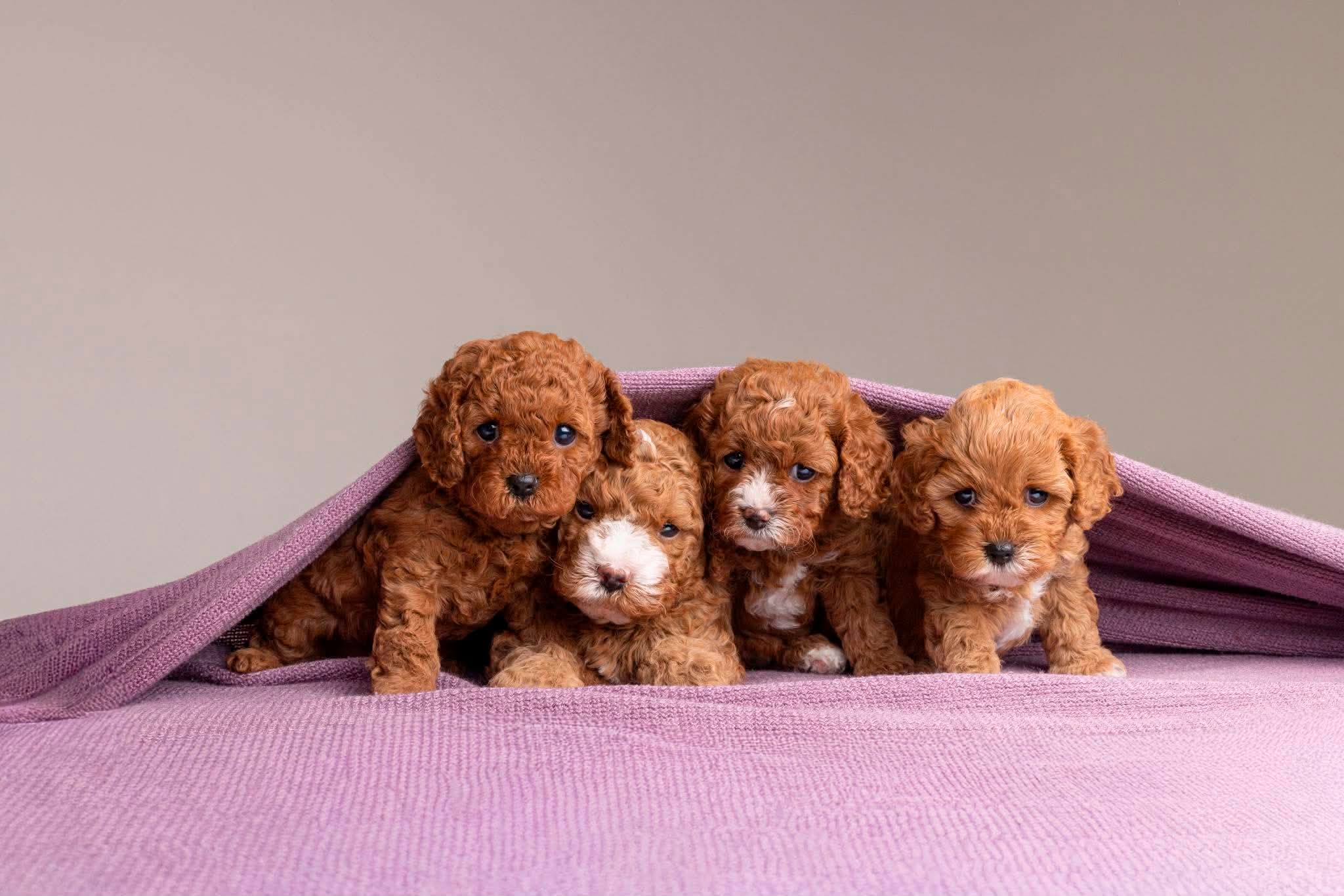
One of the most common questions we hear from prospective puppy families is:
“Are F1 Cavoodles healthier than multigenerational Cavoodles?”
The short answer is: not necessarily.
The answer lies in understanding a genetic concept known as hybrid vigor and recognising that a puppy’s health depends on much more than whether it is an F1, F1b or multigenerational Cavoodle.
What Is Hybrid Vigor?
Hybrid vigor, also known as heterosis, occurs when two unrelated breeds are crossed.
In the case of an F1 Cavoodle, a purebred Cavalier King Charles Spaniel is bred to a purebred Poodle. Because the two breeds have different genetic backgrounds, there is a reduced chance that both parents will carry the same recessive genetic condition.
This can lower the risk of certain inherited diseases being passed on to puppies.
Hybrid vigor is a genuine genetic phenomenon and is one reason why crossbreeding has become popular.
However, it is important to understand what hybrid vigor can—and cannot—do.
The Limits of Hybrid Vigor
Hybrid vigor is often oversimplified online, leading many people to believe that an F1 puppy is automatically healthier than every other generation.
The reality is more complicated.
Hybrid vigor:
✔️ May reduce the likelihood of some recessive genetic diseases
✔️ Can increase genetic diversity
But it does not:
❌ Eliminate inherited diseases
❌ Guarantee a healthy puppy
❌ Influence how a puppy is raised and socialised
❌ Replace proper health testing
If both parent breeds carry the same health issue, crossing them does not magically remove that risk.
What Does the Research Say?
Several large-scale canine genetic studies have shown that mixed-breed dogs are not universally healthier than purebred dogs.
Research from UC Davis involving more than 27,000 dogs found that for many inherited conditions, mixed-breed dogs and purebred dogs were affected at similar rates. Other studies examining popular “designer breeds” such as Cavoodles, Labradoodles and Cockapoos have reached similar conclusions.
What researchers consistently find is that health outcomes are heavily influenced by:
- Health testing
- Breeding decisions
- Genetic diversity
- Responsible breeding practices
In other words, the breeder’s decisions matter far more than the generation label alone.
What Do F1, F1b and Multigenerational Actually Mean?
Many puppy buyers assume generation labels tell them something about health.
In reality, these labels simply describe ancestry.
F1 Cavoodle
An F1 Cavoodle is a first-generation cross between a purebred Cavalier King Charles Spaniel and a purebred Poodle.
F1b Cavoodle
An F1b Cavoodle is typically an F1 Cavoodle bred back to a Poodle.
These puppies often have curlier coats and may be more predictable in coat type.
Multigenerational Cavoodle
A multigenerational Cavoodle is produced by breeding Cavoodles to other Cavoodles over several generations.
This allows breeders to selectively improve and stabilise traits such as:
- Temperament
- Coat type
- Structure
- Size predictability
- Genetic diversity through careful breeding programs
The term “multigenerational” simply describes ancestry. It does not automatically mean better or worse health.
Why We Choose Multigenerational Breeding
At Harley & Co Cavoodles, our focus is not on producing a particular generation label. Our focus is on producing healthy, well-adjusted family companions.
Over multiple generations, we carefully select breeding dogs based on:
- Comprehensive DNA testing
- Temperament
- Health history
- Structure
- Coat quality
- Genetic compatibility
This allows us to produce puppies with the characteristics many families love about Cavoodles while continuing to prioritise health and wellbeing.
What Puppy Buyers Should Really Ask
Rather than focusing solely on whether a puppy is F1 or multigenerational, consider asking your breeder:
- What health testing has been completed on both parents?
- Can I see the results?
- Why were these two dogs selected for breeding?
- How are puppies raised during their first eight weeks?
- Do you track the long-term health of your breeding lines?
- What support do you provide after puppies go home?
A responsible breeder will welcome these questions and be happy to discuss their breeding program openly.
The Bottom Line
Hybrid vigor is real, but it is not a magic guarantee of health.
An F1 Cavoodle may benefit from increased genetic diversity, but that alone does not make it healthier than a carefully planned multigenerational Cavoodle.
Ultimately, a healthy puppy comes from thoughtful breeding decisions, comprehensive health testing, responsible puppy raising, and a breeder committed to the long-term wellbeing of their dogs.
When choosing a puppy, focus less on the letters and numbers and more on the breeder behind them.
Because a healthy, happy puppy is the result of generations of careful decisions—not just a generation label.
References
Bellumori TP, Famula TR, Bannasch DL, Belanger JM, Oberbauer AM. Prevalence of inherited disorders among mixed-breed and purebred dogs: 27,254 cases (1995–2010). Journal of the American Veterinary Medical Association. 2013;242(11):1549–1555. https://doi.org/10.2460/javma.242.11.1549
A large UC Davis study that looked at more than 27,000 dogs and 24 different inherited health problems. For about half of those problems, mixed-breed dogs were just as likely to be affected as purebreds. For the rest, the picture was mixed. It’s the study most often pointed to when someone wants to show that “mixed breeds are healthier” is an oversimplification.
Bryson GT, O’Neill DG, Brand CL, Belshaw Z, Packer RMA. The doodle dilemma: How the physical health of ‘Designer-crossbreed’ Cockapoo, Labradoodle and Cavapoo dogs’ compares to their purebred progenitor breeds. PLOS ONE. 2024;19(8):e0306350. https://doi.org/10.1371/journal.pone.0306350
A 2024 Royal Veterinary College study that compared the health of three popular crossbreeds to the parent breeds they come from. For most health problems, the crosses weren’t any healthier or any less healthy than the purebreds. The study lumped all the dogs together without separating out which breeders health test and which don’t, so what it really shows is how the crossbreed is doing overall (which includes strays, puppy mills, and low-welfare breeding programs), not what a careful breeding program produces.
Donner J, Anderson H, Davison S, et al. Frequency and distribution of 152 genetic disease variants in over 100,000 mixed breed and purebred dogs. PLOS Genetics. 2018;14(4):e1007361. https://doi.org/10.1371/journal.pgen.1007361
A study of more than 100,000 dogs that tested for 152 known genes that cause health problems. Mixed-breed dogs often carried these genes, but usually only one copy. That’s what protects them from some of the recessive diseases that hit certain purebreds harder. Purebreds were more likely to actually have two copies and be affected. A clear example of what hybrid vigor does and what it doesn’t.
Nicholas FW, Arnott ER, McGreevy PD. Hybrid vigour in dogs? The Veterinary Journal. 2016;214:77–83. https://doi.org/10.1016/j.tvjl.2016.05.013
A University of Sydney review of what the research actually says about hybrid vigor in dogs. The conclusion: the genetics behind hybrid vigor is real, but the health benefit you can actually measure across crossbred dogs is smaller and less reliable than people tend to assume. The review only looked at the cross itself. It didn’t factor in what individual breeders do, which is where most of the difference in puppy health really comes from.
Trupanion insurance claims data on one popular crossbreed, presented at a 2024 breeders educational conference held in Fort Worth, TX, April 2024.
Claims data from one of the largest pet insurance companies in North America, with more than three million pets in its database. For the same crossbreed, dogs from breeders who are required to health test before breeding had claim rates roughly 36 times lower than dogs from breeders who aren’t. For elbow dysplasia, the screened group had no claims at all.