
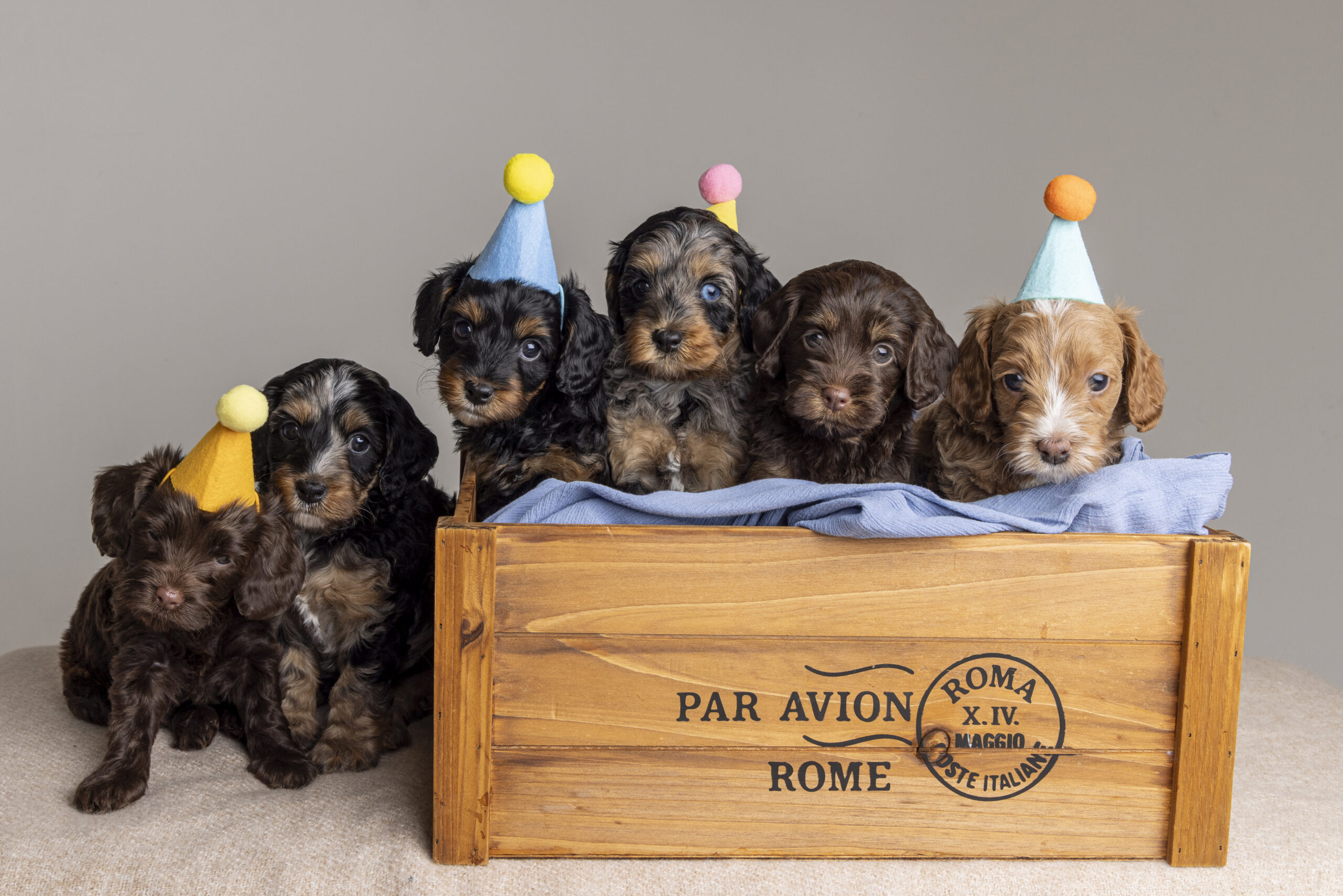
Why a little independence is one of the greatest gifts you can give your new puppy.
Bringing your Harley & Co puppy home is such an exciting time! There are cuddles to be had, toys to play with, new things to explore and, of course, a gorgeous little puppy who wants to be wherever you are.
And who can blame you for wanting to spend every waking moment with them?
But here’s something we encourage all our puppy families to remember: teaching your puppy to be comfortable without your constant attention is just as important as teaching them to sit, come when called or sleep in their crate.
One of the most valuable things you can do in those first few weeks is help your puppy understand that being alone is safe, normal and nothing to worry about.
This doesn’t mean leaving them to cry or expecting them to cope with long periods of isolation. It means gently building their confidence, one little experience at a time.
The work begins before your puppy comes home
At Harley & Co, our puppies are raised through our From Whelp to Woof! development program, which includes age-appropriate enrichment, socialisation, crate familiarisation and opportunities to develop independence.
We spend an enormous amount of time interacting with our puppies, introducing new experiences and helping them build confidence in the world around them.
But we also recognise that puppies need to learn how to do absolutely nothing!
In her article Attention Monster Puppies, Jane Messineo Lindquist from Puppy Culture discusses the importance of teaching puppies that humans are not always available for interaction.
A puppy who receives attention every time a person enters the room may begin to expect that every human movement means something exciting is about to happen.
The same puppy can become frustrated when their family needs to cook dinner, answer the phone or simply sit down and relax.
By giving puppies opportunities to settle independently, we help them develop an important life skill: being comfortable when nothing particularly exciting is happening.
Our goal isn’t to raise puppies who never need us. It’s to raise puppies who feel secure enough that they don’t need our attention every second of the day.
And this is where you come in!
The first few days: Let your puppy settle in
When your puppy first arrives home at around eight weeks of age, everything is new.
They have left their mum, littermates, familiar surroundings and the people who have cared for them since birth.
Even a confident, well-socialised puppy may initially feel unsettled.
For the first few days, focus on helping your puppy feel safe and establishing a predictable routine.
Spend time together, introduce their sleeping area and allow them to become familiar with the sounds and activities of your household.
You don’t need to start leaving them alone for extended periods immediately.
Instead, begin with small, positive experiences that show your puppy they can relax without being the centre of attention.
Remember, independence is something we teach gradually. It isn’t something we expect a baby puppy to understand overnight.
1. Teach your puppy that your presence doesn’t always mean playtime
This is one of the simplest and most valuable exercises you can do.
Set your puppy up in their familiar puppy pen with a comfortable bed, water and a safe, age-appropriate enrichment toy.
Then sit nearby and do something ordinary.
Read a book. Answer some emails. Fold the washing. Watch television.
You don’t need to talk to your puppy, entertain them or constantly make eye contact.
You’re simply showing them that sometimes you’re nearby, but you’re busy doing your own thing.
Your puppy might initially watch you, wander around or look for something to do.
That’s perfectly normal.
When they settle down, quietly allow them to enjoy their rest.
Over time, your puppy begins to learn that your presence doesn’t always mean something exciting is about to happen.
And that’s a wonderful thing!
2. Make their puppy pen a happy place
A puppy pen is one of our favourite tools for helping puppies develop independence.
It gives your puppy a safe, familiar space where they can rest, play and enjoy enrichment activities without needing you beside them.
We recommend continuing to use a puppy pen when your Harley & Co puppy comes home.
Make it inviting with:
- A comfortable bed and access to fresh water.
- A familiar blanket or bedding.
- A safe chew or age-appropriate enrichment toy.
- A suitable food puzzle or stuffed puppy-safe enrichment toy, where appropriate and supervised.
Start by allowing your puppy to enjoy their pen while you’re nearby.
You might give them part of their meal in a food puzzle while you prepare your own breakfast.
Or let them enjoy a safe chew while you sit at the dining table.
The aim is for your puppy to associate their pen with comfort, relaxation and enjoyable experiences.
Their pen should never feel like a punishment or somewhere they are sent because they’ve done something wrong.
Once your puppy is comfortable settling there with you nearby, you can begin introducing short periods when you’re out of sight.
3. Practise tiny moments of separation
You don’t need to leave the house to begin teaching your puppy that being apart from you is okay.
In fact, the best place to start is often within your own home.
Once your puppy is relaxed in their pen, try stepping into the kitchen for a few seconds.
Return before they become distressed.
Later, you might walk into another room, collect something and come back.
As your puppy becomes more comfortable, gradually increase the time you’re away.
For example, you might progress from a few seconds to 15 seconds, then 30 seconds and eventually a minute or two.
These aren’t deadlines or targets. Some puppies will progress quickly, while others need much smaller steps.
If your puppy becomes worried, shorten the next separation and practise at an easier level.
The goal is to build a history of calm, successful experiences rather than seeing how long your puppy can tolerate being alone.
Your puppy should learn that you leaving is ordinary, and that you always come back.
4. Don’t make every departure a big event
It’s tempting to give your puppy a huge cuddle, tell them how much you’ll miss them and make a fuss every time you leave the room.
But we want departures and reunions to feel like normal, everyday events.
Practise moving around your home without always inviting your puppy to follow you.
Pick up your keys. Put on your shoes. Walk to another room.
Sometimes these things will mean you’re going somewhere. Sometimes they won’t.
When you return, greet your puppy calmly and naturally.
You don’t need to ignore them, but you also don’t need to turn every reunion into an exciting celebration.
The more ordinary these little comings and goings become, the easier it can be for your puppy to understand that being apart is simply part of everyday life.
5. Use enrichment to encourage independent play
Enrichment is a huge part of our philosophy at Harley & Co.
From textured surfaces and sensory experiences to puzzles, tunnels and age-appropriate problem-solving activities, our puppies have plenty of opportunities to explore and learn.
But enrichment doesn’t always need to involve you!
When your puppy comes home, encourage them to enjoy some activities independently.
You might offer a snuffle mat containing part of their breakfast, a suitable food puzzle or a puppy-safe chew.
Start with activities your puppy already understands and enjoys.
Stay nearby initially, then gradually increase the distance between you as they become more confident.
Always choose toys appropriate for your puppy’s age and size, and supervise activities that could present a choking or chewing hazard.
The aim is to help your puppy discover that they can enjoy themselves without needing a human to provide constant entertainment.
6. Encourage daytime naps without constant cuddles
Puppies need plenty of sleep, and overtired puppies can become particularly unsettled, mouthy and demanding.
While there’s absolutely nothing wrong with enjoying a puppy cuddle, try not to make your lap the only place your puppy ever falls asleep.
Encourage regular naps in their own comfortable sleeping space.
After a toilet break, a little playtime and a meal, your puppy may naturally begin to feel sleepy.
This is a lovely opportunity to guide them towards their bed or pen and allow them to settle.
You can stay nearby while they drift off, gradually reducing how much support they need as they become more comfortable.
Learning to sleep in their own space is an important part of developing confidence and independence.
And don’t worry — there will still be plenty of opportunities for cuddles!
7. Practise being home without being available
This is particularly important for families who work from home.
It’s easy to fall into the habit of allowing your puppy to follow you everywhere, sit on your lap during meetings or receive attention whenever they ask for it.
But eventually, you’ll need to take a phone call, attend an appointment or leave the house.
Try building independent time into your normal working day.
Your puppy might enjoy a food puzzle in their pen while you’re on a video call.
They might have a nap while you work at your desk.
Or they might simply lie on their bed while you move around the room.
These ordinary moments help your puppy understand that they can feel safe and relaxed even when you’re not actively interacting with them.
Being physically close to your puppy and being constantly available to them are two very different things.
8. Gradually introduce real departures
Once your puppy is comfortable with short periods apart inside the house, you can begin practising brief departures.
Start with something very small, such as stepping outside your front door and returning a few seconds later.
You might then progress to collecting the mail or taking the rubbish out.
If your puppy remains relaxed, gradually extend the duration.
A pet camera can be helpful because it allows you to see what your puppy does when you’re not there.
Are they resting, chewing or quietly exploring?
Or are they pacing, repeatedly barking, panting or showing other signs of distress?
Use your puppy’s behaviour to guide how quickly you progress.
It’s also important to arrange company or care when you need to be away longer than your puppy can comfortably manage.
At eight weeks old, puppies still need frequent toilet breaks, meals, supervision and companionship. They aren’t ready to spend an entire working day alone.
What if my puppy cries?
This is an important distinction.
A puppy who briefly complains because you’ve stopped playing is not necessarily experiencing separation anxiety.
But a puppy who is frightened, panicking or becoming increasingly distressed needs your help.
Before assuming your puppy is simply seeking attention, consider whether they might need the toilet, be hungry, overtired, uncomfortable or struggling with an unfamiliar environment.
If your puppy is genuinely distressed, don’t leave them to cry it out.
Comfort them, help them feel safe and make the next separation easier.
If your puppy repeatedly struggles when left alone, seek guidance from a qualified, reward-based trainer or veterinary behaviour professional.
Persistent distress is not something puppies should simply be expected to outgrow.
The goal is to teach confidence, not force independence.
A simple independence routine for your new puppy
Every puppy is different, but here’s an example of how you might incorporate independent time into an ordinary day.
|
Time |
Activity |
|
Morning |
Toilet break, breakfast and a little playtime together. |
|
After breakfast |
Puppy enjoys a food puzzle in their pen while you make your coffee. |
|
Mid-morning |
A short, calm nap in their own sleeping space. |
|
Lunchtime |
Toilet break, playtime and a little training. |
|
Afternoon |
Practise stepping out of sight for a few seconds while your puppy is relaxed. |
|
Early evening |
Puppy enjoys a safe chew while the family prepares dinner. |
|
Bedtime |
A predictable, comforting bedtime routine in their familiar sleeping space. |
These activities should be adapted to your puppy’s individual needs, feeding schedule and toilet routine.
There’s no need to practise separation constantly or turn every moment into a training exercise.
A few short, positive experiences throughout the day are far more valuable than pushing your puppy beyond what they can comfortably manage.
Finding the balance between love and independence
One of the things we love most about Cavoodles and Theodores is their affectionate, people-oriented nature.
They thrive on companionship and often form incredibly close bonds with their families.
We certainly don’t want to change that!
We want our puppies to love being with their people while also feeling secure when those people need to do something else.
You can absolutely cuddle your puppy, let them curl up beside you and enjoy all the wonderful moments that come with welcoming a new family member.
Just remember to give them opportunities to discover that they can also relax, play and rest independently.
A confident puppy isn’t one who never needs you. It’s one who feels safe knowing that a little time apart is okay.
Our final thoughts from Harley & Co
The first few weeks in your puppy’s new home are a wonderful opportunity to build habits that will support them throughout their life.
At Harley & Co, we put an enormous amount of love, thought and effort into giving our puppies the best possible start through our From Whelp to Woof! development program.
But their learning doesn’t stop when they leave us at eight weeks old.
By continuing their enrichment, maintaining predictable routines and gently introducing independent time, you’re helping your puppy develop the confidence to navigate everyday life.
Remember, the aim isn’t to prevent your puppy from ever experiencing a moment of frustration or uncertainty. It’s to give them the skills and support they need to cope with ordinary, age-appropriate experiences.
And if your puppy needs a little extra reassurance along the way, that’s okay too.
Every puppy develops at their own pace, and we’re always here to support our Harley & Co families as their puppies grow.
Because raising a happy, confident puppy is about more than teaching them how to be with us. It’s also about helping them feel safe when we’re not right beside them.
With love,
Laurinda & Craig
Harley & Co Cavoodles & Theodores